Sunday, June 24, 2012

Big Ten in the NBA


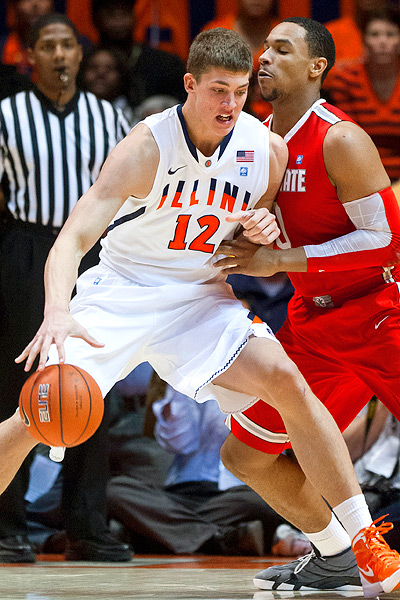
Think you may want to draft Jared Sullinger's big ole ass?  Like the cut of Meyers Leonard's jib?  I decided to use historical indicators to project the NBA potential for players coming out of the Big Ten.  For several years, the Big Ten has been criticized greatly for a slower, plodding style that can't match up to more athletic and explosive teams from other conferences...in football.  In basketball, however, the Big Ten consistently churns out excellent, if not at least overachieving, tournament performances from its members.  Have its top basketball players moved on to become noteworthy NBA players?  Let's take a look at the last ten years of first round picks from the NBA:

2002
#11 - Jared Jeffries
#25 - Frank Williams

2003
#24 - Brian Cook

2004
#5 - Devin Harris

2005
#3 - Deron Williams
#24 - Luther Head

2006
#25 - Shannon Brown
#28 - Maurice Ager

2007
#1 - Greg Oden
#4 - Mike Conley
#21 - Daequan Cook
#29 - Alando Tucker

2008
#7 - Eric Gordon
#23 - Kosta Koufos
#29 - D.J. White

2009
#24 - B.J. Mullens

2010
#2 - Evan Turner

2011
#25 - JaJuan Johnson

I thought this was a surprising case study.  Out of eighteen first round picks over ten years, only four players have become above average starting caliber players:  Eric Gordon, Mike Conley, Deron Williams, and Devin Harris.  In fairness, Evan Turner has shown promise, but only has two seasons under his belt, and the Greg Oden tragedy is not really his fault.   Nonetheless, it's hard to believe that a conference as strong as the Big Ten has only produced four starting-caliber first round picks over the last decade.

This trend may be completely coincidental, and I don't have any strong theories on why we haven't seen more NBA success out of this conference.  I suppose a case could be made that the Big Ten, by and large, lacks a sufficient number of athletes to provide NBA-caliber matchups for the conference's elite players.  For example, a few more agile, 6'11" shot blockers could have given a better idea of whether Koufos, D.J. White, Mullens, or Sullinger were/are likely to be able to score close to the basket in the NBA.  This list wouldn't change the way I feel about Draymond Green, because any team drafting him shouldn't expect him to be a long-term starter.  However, there are enough concerns about Leonard and Sullinger that this list would give me a little extra pause in drafting them.

Saturday, June 16, 2012

Your Move, Charlotte


One of the main characters from "Sex and the City" was named Charlotte. In my limited exposure to that show, I did not enjoy it (Kim Cattrall wasn't slutty enough for my taste). Somehow, however, that's the closest to success that I can place the Bobcat franchise. The Charlotte Bobcats are not one player away from being a great team.  At this point, they'll be in contention for the top draft pick next year regardless of who they draft with the second overall pick on June 28th.  Nonetheless, it's essential that they capitalize on their first selection in the 2012 draft.  Anthony Davis to New Orleans is a foregone conclusion, and the cast of characters for the second overall pick has expanded to include about a half dozen candidates.  Thomas Robinson, Andre Drummond, Bradley Beal, Michael Kidd-Gilchrist, and Harrison Barnes are all vying for this "honor."  Michael Jordan has been the architect of the crumbling edifice that is the Charlotte Bobcats, but who will he target for the next phase of this project?

Drummond has the highest ceiling, but his bust potential is undeniable.  His motor is a red flag, and most guys don't become hungrier AFTER they earn their first million.  He also teetered at the 40% threshold on free throws during the season.  How much can anyone hope for him to improve there?  Even if he improves by 50%, he's a 60% free throw shooter.  He has no go-to post moves.  So your worst case scenario is a big with no post moves, can't be in at the ends of games due to poor free throw shooting, and we don't know if he'll develop the intensity to have a defensive presence to overcome his potential offensive shortcomings.  I don't hate Drummond, but it's too good of a draft to risk the second pick on him.

Harrison Barnes' second season at UNC exposed him as somewhat one dimensional.  He's a very dangerous at catching and shooting, and is outstanding at pulling up off one to two dribbles.  He has good athleticism, but doesn't utilize it in either rebounding or defending.  I think the hate on Barnes has gone too far, but I think the key with drafting him is not expecting him ever to become the best player on your team.  He's a second fiddle who can open the floor with his shooting.  In a less tangible area, I would worry about Barnes struggling under Jordan's influence.  I won't call him soft, but I think it takes a real SOB to thrive under Jordan's domineering personality, and Barnes doesn't seem to be that guy.

Kidd-Gilchrist is the opposite of Barnes, but somehow also feels like a poor fit for Charlotte.  Don't draft MKG hoping him to be your franchise player.  Also, many compare him to Gerald Wallace, who the Bobcats traded away for fifty cents on the dollar a year ago.  If they valued Wallace so little, how can they justify drafting MKG?

Beal makes, sense, but for some reason, his stock seems to be slipping.  Also, his game isn't that different from Gerald Henderson...although, I won't advocate not drafting anyone because you already have Gerald Henderson.  If Charlotte likes Beal, then trade back a few picks and nab him there.

This leaves Robinson, and guess what?  I did that on purpose. T-Rob is the right pick for Charlotte for a lot of reasons.  He WANTS to be a franchise player.  There is no questioning his intensity.  He still talks about how he is better than Anthony Davis.  It makes him look kind of dumb when he does that, but know what doesn't look dumb?  His shoulders.  If you love Drummond because he passes the look test, then cast your gaze upon Robinson's chiseled frame, which pairs nicely with a much, much more impressive utilization of that physique.  I think Robinson could have a Blake Griffinesque impact for the Bobcats.  He's barely undersized at PF, and he does not appear to be an elite defender.  However, he's going to rebound the hell out of the ball, and he will be one of the most athletic 4s in the Eastern Conference from Day 1.  He also has that chip on his shoulder attitude that Jordan values so much. Take Robinson at 2, then take the best players, regardless of position for your next six picks, because you're terrible, Charlotte.

Tuesday, April 24, 2012

Big East Honors & Awards


All Big-East

Darius Johnson-Odom, Marquette
#1 Senior Guard 6-2 215
18.3ppg 3.5rpg 2.7apg

Jason Clark, Georgetown
#21 Senior Guard 6-2 180
14.0ppg 4.1rpg 1.6spg

Kris Joseph, Syracuse
#32 Senior Forward 6-7 215
13.4ppg 4.7rpg 1.4spg

Jae Crowder, Marquette
#32 Senior Forward 6-6 235
18.3ppg 8.4rpg 2.5spg

Kevin Jones, West Virginia
#5 Senior Forward 6-8 260
19.9ppg 10.9rpg .509FG%

Connecticut's Jeremy Lamb, for all his talent and potential, misses the cut after the Huskies (and Lamb, at times) turned in an uninspired 2011-12 campaign.

Player of the Year: Jae Crowder, Marquette
Crowder was a poor man's Larry Johnson for Buzz Williams' Golden Eagles, regularly overwhelming the opposition with his physicality on both ends of the floor.

Top Defender: Gorgui Dieng, Louisville
Dieng, who anchored the nation's most efficient defense while averaging 3.2 blocks per contest (good for 8th best in the country), edges out Seton Hall's Fuquan Edwin, who averaged 3.0 swipes per contest (second in the NCAAs).

Best Freshman: Moe Harkless, St. John's
Harkless, a versatile wing who plays like a less perimeter-oriented Joe Johnson, did it all for the Red Storm, averaging 15.3 points and 8.6 rebounds per game.

Coach of the Year: John Thompson III, Georgetown
While Notre Dame's Mike Brey and Louisville's Rick Pitino are both deserving, JT3 led a team projected to finish tenth in the Big East preseason poll to a 3 seed in the NCAA Tourney.

Thursday, April 12, 2012

ACC Honors & Awards


All-ACC

Kendall Marshall, North Carolina
#5 Sophomore Guard 6-4 195
8.1ppg 9.8apg 1.2spg

Harrison Barnes, North Carolina
#40 Sophomore Forward 6-8 215
17.1ppg 5.2rpg 1.1spg

Mike Scott, Virginia
#23 Senior Forward 6-8 235
18.1ppg 8.4rpg .563FG%

John Henson, North Carolina
#31 Junior Forward 6-11 220
13.7ppg 9.9rpg 2.9bpg

Tyler Zeller, North Carolina
#44 Senior Center 7-0 250
16.3ppg 9.6rpg 1.5bpg

Yes, it is gross that four Tar Heels are among the conference's top five performers.

Player of the Year: Tyler Zeller, North Carolina
Big Z edges out UVA's Mike Scott in what was a highly competitive race for the conference's top honor.

Top Defender: John Henson, North Carolina
Despite his tendency to play out of position, Henson's ability to alter and block shots (tenth in NCAA) played a large part in the Tar Heels' oft-criticized defense finishing as the nation's eleventh most efficient.

Best Freshman: Austin Rivers, Duke
Rivers led the 27-win Blue Devils in scoring at 15.4 points per contest and rounded into one of the most dangerous scorers in the country.

Coach of the Year: Leonard Hamilton, Florida State
The Seminoles beat the Tar Heels and the Blue Devils twice apiece and rode their stingy, physical defense to an ACC Tournament Championship and a 3 seed in the NCAA Tourney.

Friday, April 6, 2012

Kentucky wins #8.

The Kentucky Wildcats are the 2011-12 National Champions. After knocking off rival Louisville in the Final Four and then topping Kansas in the championship game, the Wildcats took home title number eight. It was an incredibly impressive season for the Cats. They began the 2011-12 campaign as the co-favorite (along with North Carolina) to win the title. With the Tar Heels stumbling in the early going, John Calipari's squad was pretty much the best team in the country from beginning to end. Kentucky dropped a game at Assembly Hall in Bloomington to the Hoosiers in December and lost a second game in the SEC tourney against a Vanderbilt team it had already beaten twice before. Outside of those two hiccups, UK was dominant from start to finish. Anthony Davis was the best player in the country and one of the best defenders the college game has ever seen. Michael Kidd-Gilchrist, one of the country's fiercest competitors, had a spectacular freshman year in his own right. Terrence Jones failed to live up to his preseason accolades but put together a very solid season. Doron Lamb continued to be one of the craftiest scorers in the NCAAs. Darius Miller provided savvy veteran leadership, became one of the college ranks' most dependable crunch-time performers, and proved to be a player capable of playing at the next level. While Marquis Teague struggled in the early part of the season, he finished the year as the National Champions' very capable floor general. And Calipari, regardless of what his detractors may say about his methods and his vacated trips to the Final Four, put together one of the five best coaching jobs of the 2011-12 season. Sure, he had a ton of talent, but he also molded a group of freshmen and sophomores into a championship caliber team in about eight months. And he had this group of future first-round picks playing selfless, ego-less basketball. The Wildcats' chemistry was undeniable. They put forth as much effort on defense as on offense. They deferred to one another, seemed to genuinely enjoy playing with each other, and improved as the season progressed. And then, after the Cats put the finishing touch on their masterpiece of a season, Lexington went apeshit.